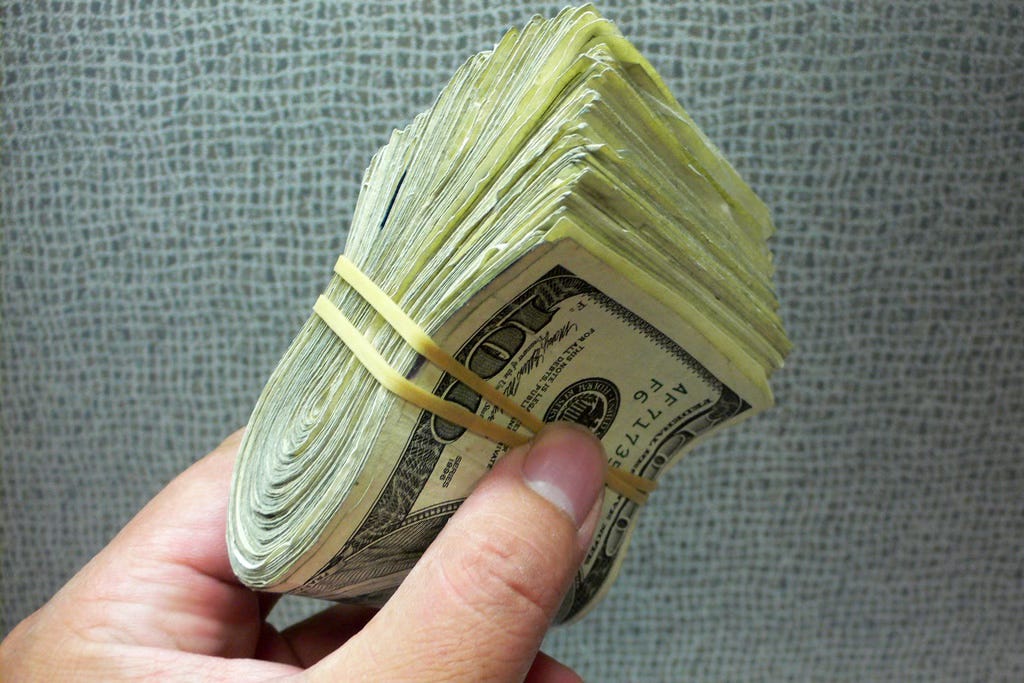
Things get messy when fat stacks hit the table
This is more a speculative essay than a good old angry rant. You know my opinions about the adverse effects of social media in the hands of the grifting “influencers”. We’ve always had frauds and charlatans peddling snake oil and potions, but the powerful manipulation of social media algorithms and reinforcement technology give those con artists 21st century behavior control tools that flimflam deceivers of the past could only dream of.
But what happens when legitimate physicians use those same communication channels to try and have a positive effect? Where are the lines? What are the risks and benefits?
I don’t have clear answers, but I do have a lot of questions. Let’s explore them.
Let’s start with an article Mrs. YAM forwarded to me from one of her favorite podcasters: Katie Couric. Katie’s got a website where she posted this article about the perils of nicotine and it’s rising popularity in wellness culture. In brief, wellness “influencers” are now talking about nicotine as some kind of “natural” treatment for a variety of conditions while overlooking, understating, or flat out misrepresenting all the negative aspect of nicotine addiction. The article goes on to give a ton of great background detail about nicotine pharmacology, adverse effects, and the role of the tobacco industry in finding new ways to promote it and lure more people into addiction. I love this article!
I thought, good for Katie, she’s still out there doing quality journalism.
But then I noticed, wait, that’s not Katie, it’s someone named Dr. Bayo Curry-Winchell. She’s described in her little bio blurb as:
“…a nationally recognized health equity advocate and maternal health expert known. As a medical correspondent, public speaker, social media content creator, and the founder and CEO of Beyond Clinical Walls, she is a trailblazer committed to driving meaningful change in healthcare.”
Who is Dr. Curry-Winchell? A quick tour through publicly available info, including her Linked In page, shows she’s a legitimate, if very busy, Family Practitioner employed by St. Mary’s health system in Reno, Nevada, but also the head of several consulting and multimedia businesses with herself at the center as a medical communicator. She’s a hustler, in the positive sense, someone who is working their ass off to build things and make a buck. Good for her.
But this is where my spider sense starts to tingle a bit. Given her prodigious media activities, what else is she selling, other than herself? She’s in with Katie Couric, which is quite an achievement. Katie is an accomplished journalist who now has her own little media empire. Katie’s selling stuff, but not too much, and Katie has a reputation to protect, and likely a small army of staff to vet and approve any sponsorships so that they don’t reflect poorly on her or undermine her credibility as a trusted source. Katie appears to think positively of Dr. Curry-Winchell. Should we?
This is the jumping off point for my concerns about doctors who do social media. The argument I see all the time from younger people is that this is where people get their information, so we have to engage on that battlefield and counter the crap information with good science and medical advice. To torture my “social media disinformation hygiene” analogy (drinking out of dirty toilet), we’re going to make sure people are drinking CLEAN water out of the toilet.
What got me on this was my research on the Vitamin K issue and finding the clown who argued against it. One of the first clips I saw was on the Instagram feed of Franziska V. Haydanek, DO, a young OB/Gyn who calls herself Dr. Fran and has her own nicely curated media thing going on. She has a post where she takes down the wellness grifter Michael Johnson about Vitamin K. I was impressed by her content, especially her tips at the end about the three rules of medical information on social media:
- what are the credentials of the person delivering the information?
- what resources or research do they reference?
- what do they stand to gain? What are they selling?
This is outstanding advice which needs to be repeated over and over to continue immunizing the general public against disinformation.
But here’s the thing: Dr. Fran is selling stuff too. In addition to an impressive array of merch, she also actively seeks partnership and promotional deals. A quick perusal didn’t show anything sketchy, it all looks pretty mainstream, but again, the tingle. Every dollar she takes trading on her credibility and audience is one that puts her one step closer to compromising something else. Does the good work she does educating consistently outweigh whatever tradeoffs, present or future, she makes to keep sponsors happy?
Then there’s Dr. Mike, who I’ve mentioned before. He’s a telegenic young guy who is all over the socials, producing a massive amount of content. From what I’ve seen, admittedly not much, he says all the right things, debunking grifter medicine and promoting the scientific method. Particularly impressive, his Youtube channel has almost 15 million subscribers! That’s some reach.
Again, the tingle: his Youtube segments have ads, and those ads generate revenue. In his case, quite a bit – his videos generally have 100’s of thousands of views, which can generate $1000 and up, depending on just how many views. Right now, he’s got over a thousand videos on the channel, and this is just Youtube. Do the math: I would not be surprised if his social media revenue is considerably larger than whatever he makes as a Family Practice primary care provider.
What’s the harm? If these people are saying the right things, educating people, pushing back on disinformation, what’s wrong with making a couple of bucks while they do it?
We should never lose sight of what happens when you go up the river and get out of the boat. Like in Heart of Darkness and Apocalypse Now, when you go up the river (taking the disinformation battle onto social media), and you get out of the boat (start making nice money doing it), you put your soul in jeopardy. There are non-trivial risks of corruption, and we know that humans don’t generally do well with temptation, greed, fame, ego, and wealth.
There’s another angle on this. In a recent post on Medium (there may be a paywall), Jess Stier of Unbiased Science makes a compelling case for a new model for science and health communication that would obviate the need for sponsorships and ads. Creating stable funding streams for professional science communicators would allow them to focus on the actual work, instead of the celebrity aspects of creating a media presence. Whether it’s through a subscription model, grants to non-profits, or steady funding from academia or the government, stable revenue takes a big part of the temptation away.
Case in point – Dr. Mehmet Cengiz Oz, our current head of CMS and one of Trump’s worst fluffers and RFK Jr. enablers. Son of physicians, impeccably trained with sterling credentials, he was an immigrant success story, ascending to the pinnacle of American medicine as a well-regarded cardiothoracic surgeon. Then, he got a taste of the limelight, and his journey into quackery and media sluttery began. According to the Wikipedia article cited above:
“In 1996, Oz and Rose received media publicity following their work on a successful heart transplant for Frank Torre, brother of New York Yankees manager Joe Torre, during the 1996 World Series, which the Yankees won. Rose later remarked that while he did not enjoy the media attention, Oz “loved it”.”
The incident resulted in the dissolution of Oz’s professional association with his former colleague Dr. Jerry Whitworth, the first of many such breaks with employers, due to the “media circus”.
Then there was Oprah, and his further descent into flimflam. You know the rest of the sad tale. Oz, Makary, Prasad, and Bhattacharya all are solidly credentialed mainstream academics who have all debased themselves in exchange for proximity to power, media fame, and maybe some money, too.
That’s why I worry about with these young, media savvy doctors getting in the social media hustle. Humans can be weak and prone to temptation, especially when fame and wealth are sitting RIGHT THERE, just out of reach. Maybe they do good things, but man, the risks. I don’t know.
This first appeared on Your Angry Pediatrician


Leave a Reply