Last month, I participated in an event called Ignite Carroll, part of the national Ignite series, where a speaker has five minutes and twenty slides to share a topic. I took a stab at it and it went well, though I was clearly outclassed by many of the other speakers who gave much more polished presentations. My challenge was my topic, a sprawling tangle I tried to tame in five minutes. The title was, “A journalist, a priest, and Albert Einstein walk into a bar…”
The three people I focused on in the talk figure prominently in my imagination and influence much of what I write, especially the science fiction. I attempted to draw a throughline connecting them to our challenges today with how we know what we know, and how we must fight disinformation.
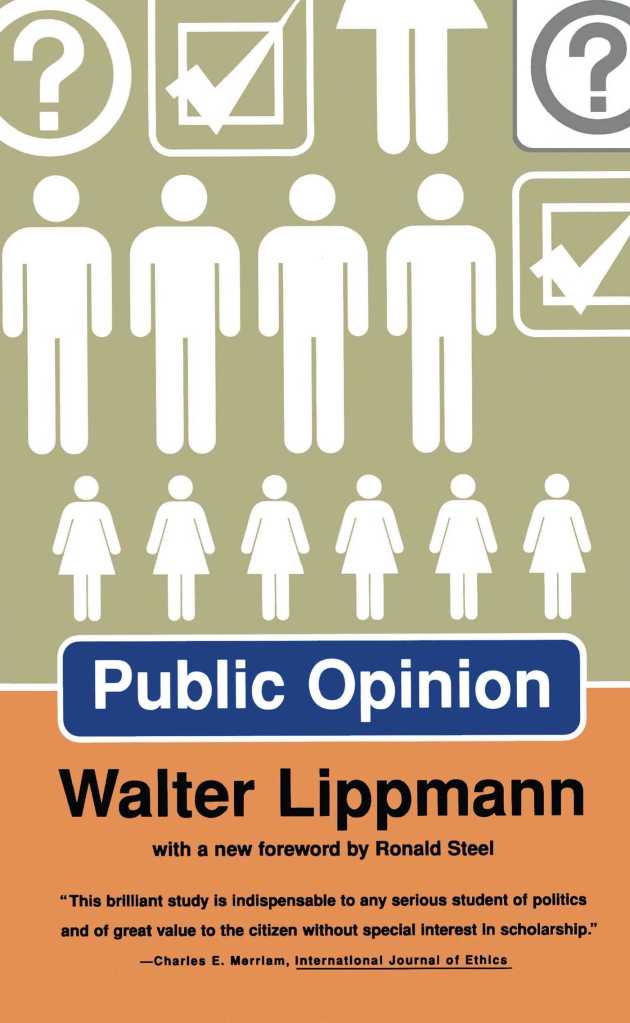
The journalist is Walter Lippmann, and his book “Public Opinion”. He published it in 1922, and is still considered a classic. Lippmann worked as a propagandist during World War I and he learned a lot about human nature, how we process information, and the most effective ways to manipulate what people think and believe.

One of the astonishing things about the book and his ideas is that he anticipates much of what we’ve subsequently learned and demonstrated in the fields of psychology and neuroscience about human cognition. I have to keep reminding myself he published this long before the invention of television, the internet, and social media, and yet his warnings are just as urgent today.
The first point Lippmann posits is that we each live inside a bubble defined by our senses. Everything we experience comes from things that impinge on the surface of that bubble. The size of the bubble is limited by the range of each sense. For example, we can only see so far, and we can only see things down to a certain size. We can only hear noises so loud, and only from a certain distance. Our memories can only hold so much information. The average human can remember about one hundred individual faces. This defines (pre-Internet) the size of our social circles, or the range of human relationships we can manage. We can only see certain wavelengths of light. Ultraviolet light and infrared are all around us, yet they are invisible. Since Lippmann’s time, we now know that many organisms can see in these wavelengths and many plants, insects, and birds have colorings that are completely invisible to us.
All our information enters our minds through our senses, and the range of our senses defines the world we experience, which is only a small part of what’s really out there.

The next point that Lippmann makes is that once an experience impinges on our sensory bubble, our first response is emotional. Through both hardwiring and experience, every sensation is categorized against a range of emotional responses. It’s only once we experience the emotional response that we begin to think. In other words, feelings precede cognition.
This is a powerful insight that is the foundation of all propaganda and disinformation, from WWI total war mobilization to today’s social media cancer. Lippmann lays out the formula quite neatly – use sensory impressions to provoke an emotional response, link that emotional response to the idea you want to promote, then provide the contextual information to build the rationalization justifying the emotional response.
This theory, elaborated by many others, is most popularly understood as the “Elephant and Rider” hypothesis. Our emotional brain is the elephant, and our rational consciousness is the rider. The rider **thinks** it is steering the elephant, but in reality, the elephant goes whereever it wants, and the rider rationalizes the movements after the fact: “Oh, the elephant turned right because I nudged it with my foot,” when in fact the elephant turned because it wanted to eat the leaves over there. Jonathan Haidt is one of the more widely read popularizers of this idea.

The implications of this idea are many, from whether we have any free will at all, to the professional responsibilities of journalists and whether (or even how) governments should regulate social media to protect society.
Next up: The Priest!
 Robert Wack
Leave a comment